Two Unrelated Images, One Continuous Shot
Given a first and last frame with nothing in common, MiniMax H3 bridges them by inventing a camera move rather than dissolving. Four pairs at increasing distance, measured for endpoint fidelity and hidden cuts — then a seamless four-season loop built on the result.
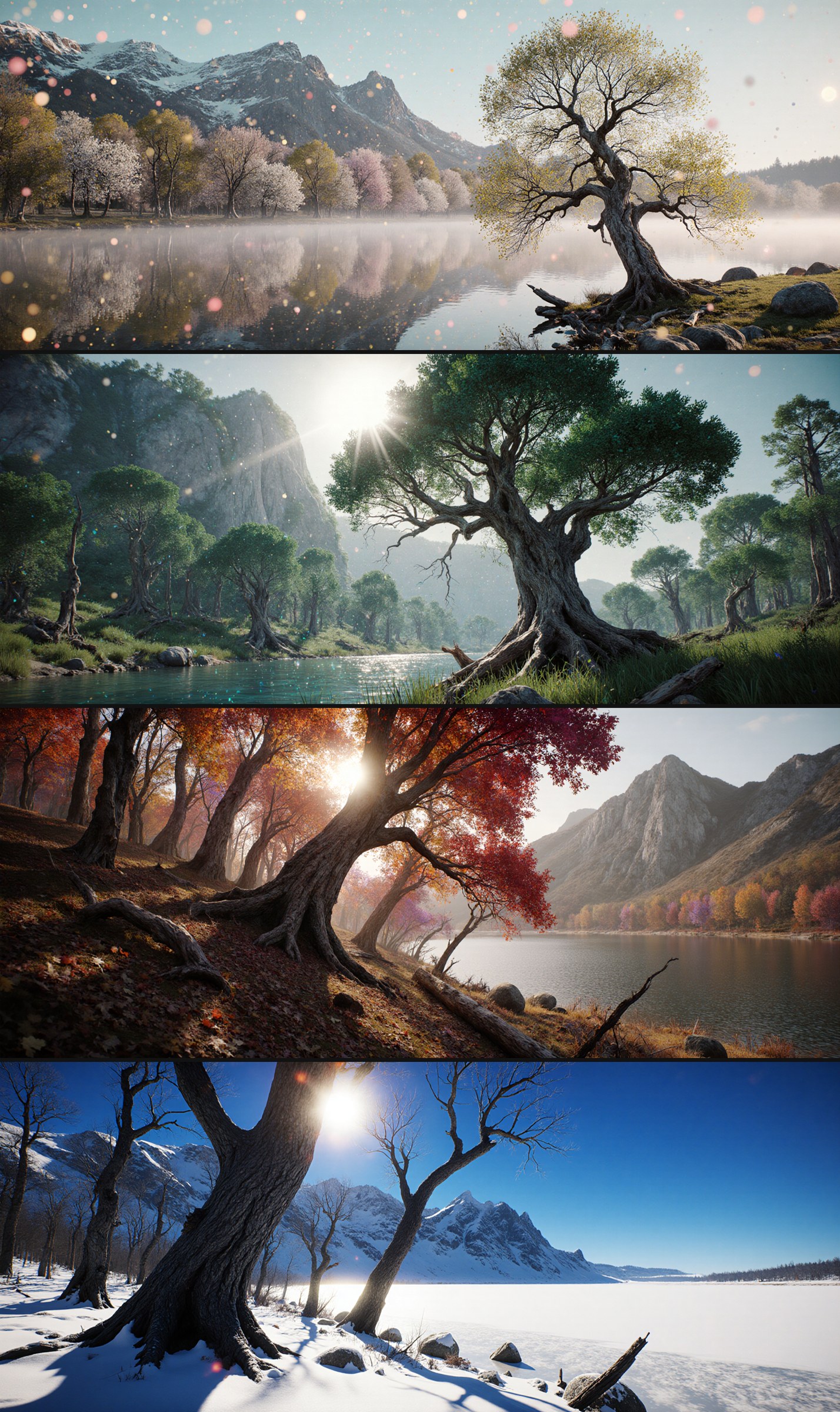
Hand a video model a first frame and a last frame that have nothing to do with each other — a turquoise tropical shallows and a birch slope in cold sunlight — and there is no obvious right answer. A crossfade is the safe one. What MiniMax H3 does instead is invent a camera move: the horizon rolls, the whole frame whips through motion blur, and it lands on the birches. One shot, no cut.
That behaviour turns out to be reliable enough to build on. This is a record of testing where it breaks, and of using it for a thing it is unexpectedly good at.
Testing it properly means varying the distance
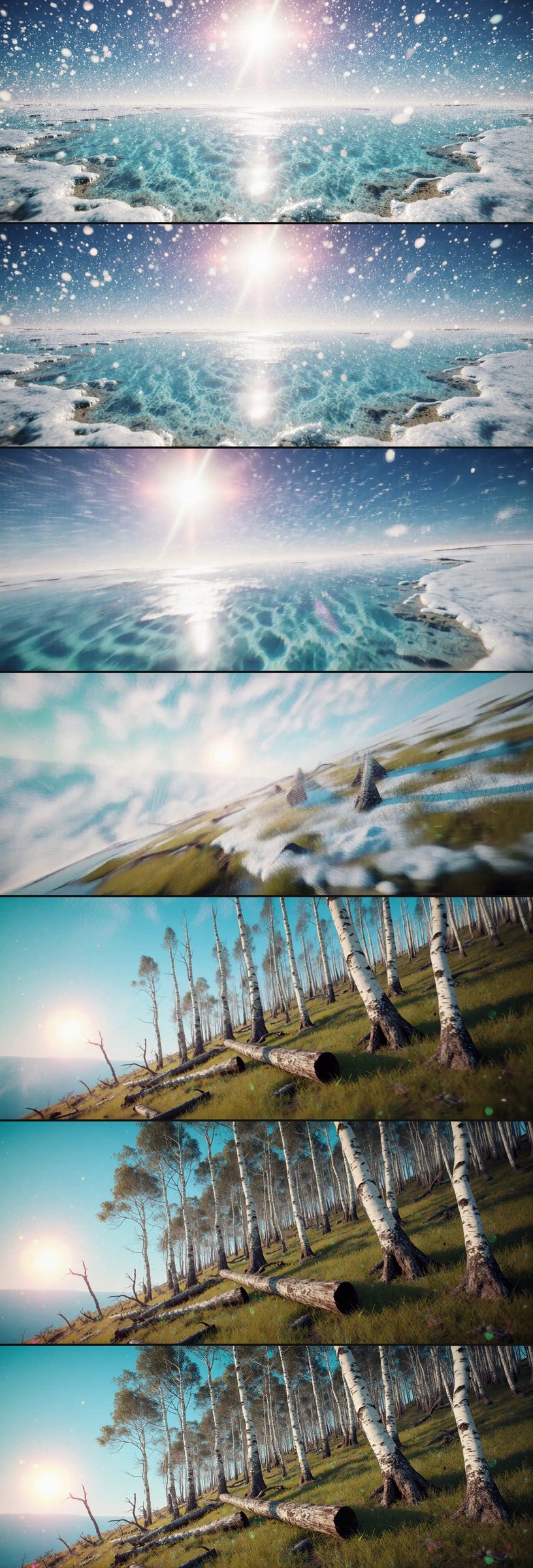
A single pair proves nothing. Two similar images will obviously connect, two unrelated ones might obviously fail, and one result tells you which case you happened to pick. So four pairs at increasing distance, the same prompt on all four, and the prompt deliberately does not say how the change should happen — only that it is one continuous shot. The question is whether the model bridges, not whether it follows instructions.
| Pair | Distance | From → to |
|---|---|---|
| near | same subject, different framing | breaking wave → sun on the horizon |
| mid | same subject, different time of day | midday cumulus → sunset anvil |
| far | different subject | tropical shallows → birch slope |
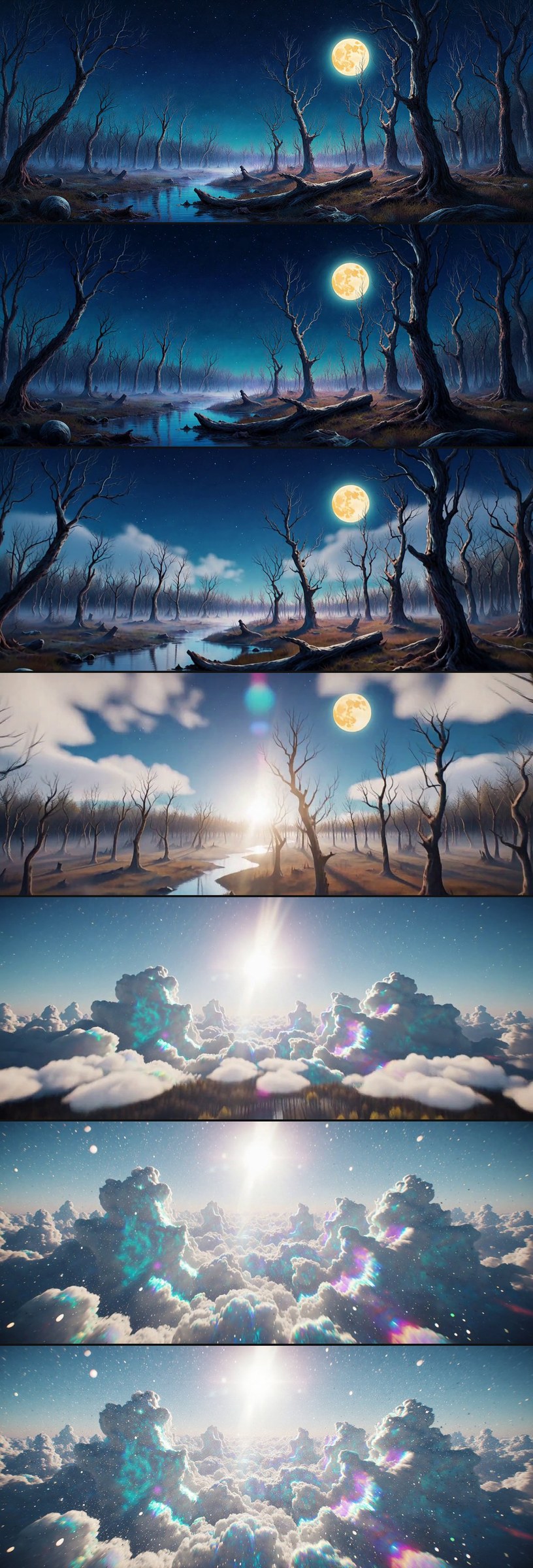
| extreme | different subject and time | moonlit night forest → iridescent cloud |
Three things get measured separately, because they are independent. A clip can honour both endpoints and still contain a hard cut in the middle; it can also move smoothly and land somewhere that is not the target.
| Pair | start vs A | end vs B | frame-to-frame median | max | ratio |
|---|---|---|---|---|---|
| near | 9.1 | 8.0 | 19.7 | 34.9 | 1.8× |
| mid | 5.3 | 5.6 | 7.3 | 15.6 | 2.1× |
| far | 8.9 | 10.7 | 23.4 | 38.4 | 1.6× |
| extreme | 7.5 | 5.8 | 22.1 | 38.9 | 1.8× |
Endpoints are mean absolute pixel difference against the source images; anything under about 25 is a match by the standard used across these notes, and 5–11 is comfortable. All four pairs hold both endpoints.
The cut test is the ratio of the largest frame-to-frame change to the median. A hard cut spikes at one point and nowhere else. Nothing here exceeds 2.1×, which is what continuous motion looks like.
The interesting part is how it bridges
Not by dissolving. By moving the camera, and by choosing a move that makes physical sense for the specific gap.
The night-forest-to-cloud pair is the clearest. The sky brightens first while the moon stays in place, the trees wash out into mist, and the camera lifts until it is above a cloud deck. It reads as time passing and altitude gained — an explanation for the change, invented without being asked for one.
The distance also shows up as a cost. Median frame-to-frame change is 7.3 on the closest pair and 22–23 on the two farthest: the more different the two images, the harder the camera works. Which connects to a separate finding in the earlier writeup — large per-frame displacement is exactly what costs a distilled few-step model its texture. The mushy middle of the far clip is that bill arriving.
Four seasons as an application
If the model will bridge two arbitrary images, then a sequence of keyframes is a sequence of bridges. Four seasons is a natural test because the endpoints are far apart in colour and content but anchored to one place.
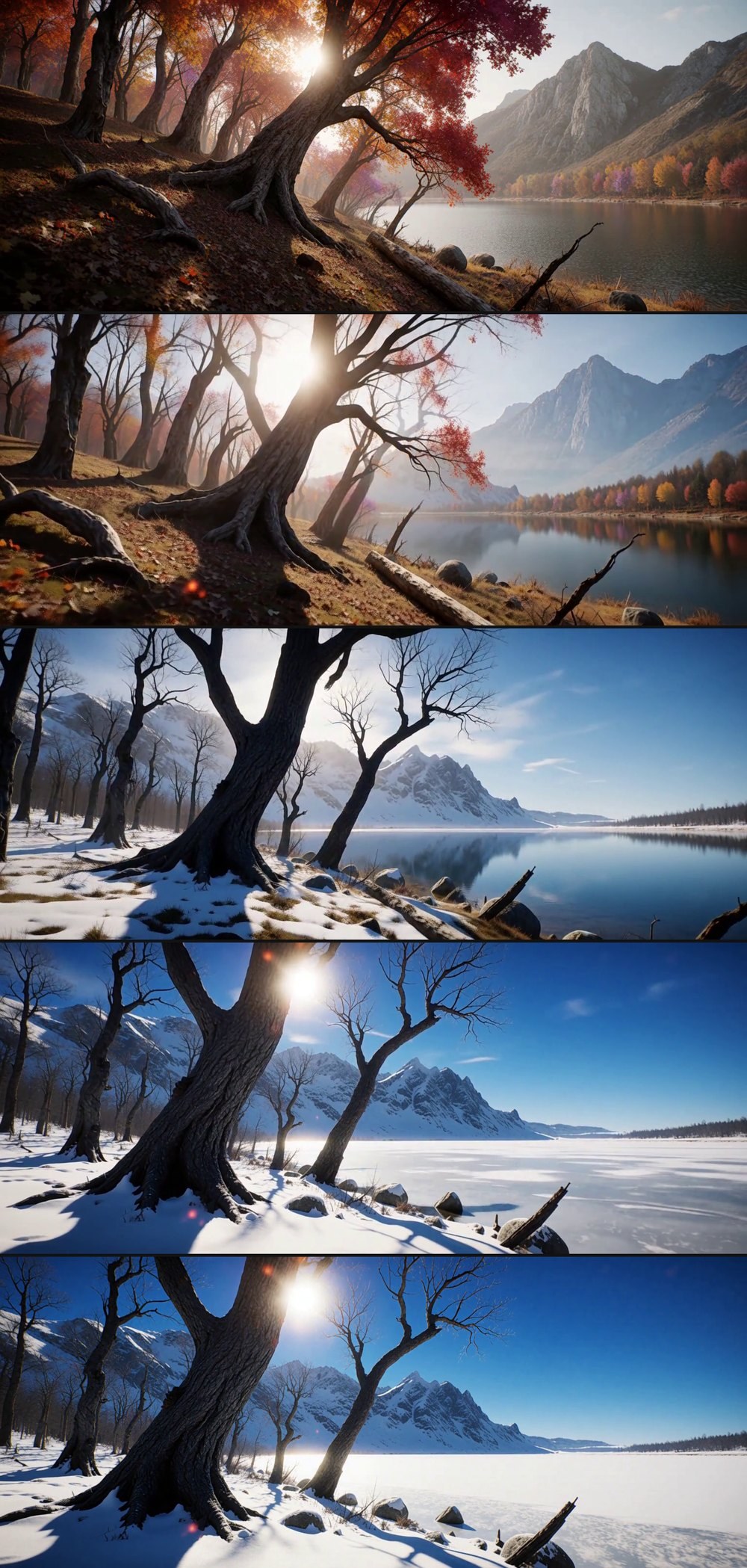
The construction: four Flux stills of the same location — one enormous gnarled tree at the edge of a lake, a jagged ridge behind it, boulders along the shore — with the camera in a different position each time. Standing still and only changing the season produces a slideshow; moving the viewpoint makes it a journey that happens to pass through a year.
| Anchor | Camera | Season |
|---|---|---|
| spring | far across the water, tree small at frame right | mist, first blossom, snow still on the ridge |
| summer | at the water's edge looking steeply up | heavy canopy, sun burning through gaps |
| autumn | high on the slope looking down | crimson and gold, leaf litter |
| winter | at the foot of the tree | black branches, frozen lake, blue and white only |
Four clips connect them, and the fourth closes winter back to spring so the whole thing loops.
Each clip states what changes over its span — the last leaves fall and the branches go bare, snow settles over the ground and the ridge, the lake freezes flat, and the camera descends from the slope to the foot of the tree — without specifying a transition mechanism.
| Leg | start | end | median | max | ratio |
|---|---|---|---|---|---|
| spring → summer | 9.6 | 9.0 | 17.5 | 23.1 | 1.3× |
| summer → autumn | 9.2 | 9.1 | 20.2 | 31.0 | 1.5× |
| autumn → winter | 9.6 | 7.2 | 16.5 | 23.0 | 1.4× |
| winter → spring | 7.6 | 9.4 | 22.1 | 31.6 | 1.4× |
The loop closes
Because consecutive clips share an anchor, the junctions should be near-identical — but "should" is not "are", so measure the last frame of each clip against the first frame of the next:
| Junction | difference |
|---|---|
| spring→summer ends, summer→autumn begins | 5.5 |
| summer→autumn ends, autumn→winter begins | 5.9 |
| autumn→winter ends, winter→spring begins | 4.0 |
| winter→spring ends, spring→summer begins | 5.7 |
The last row is the one that matters: the end returns to the beginning, so the 29-second clip repeats without a visible seam.
Length bought back the detail
The pair test ran at 124 frames (5.2 seconds); the seasons ran at 175 (7.3 seconds). Same measurement, different result:
| frames | max/median ratio | midpoint | |
|---|---|---|---|
| Bridge test | 124 | 1.6 – 2.1× | visibly smeared at 50% |
| Seasons | 175 | 1.3 – 1.5× | sharp at 25% and 50% |
Giving the transition more frames lowers per-frame displacement for the same total travel, and the texture survives. That is the same trade the camera-speed measurement described from the other direction, now confirmed on content where the move is not optional.
Caveats
- The anchors are not the same tree. Same seed and the same location description, but season and viewpoint change the generation, so the trunk differs between stills. H3 absorbs the mismatch into camera motion, which is why it reads correctly — but a stricter version would lock the subject at the Flux stage with a reference rather than a description.
- n=1 per cell. Four pairs, one seed each, one prompt. The endpoint and cut numbers are far enough apart from their thresholds that the direction is not in doubt; the magnitudes are not to be trusted at the quoted precision.
- The cut metric samples every fifth frame. A single-frame glitch between samples would not register.
Scripts and raw measurements: minimax-h3-notes.
← Back to all posts